Self-study mathematics: the order, the books, and when to move on
A full undergraduate curriculum you can follow alone, from calculus to measure theory and manifolds, with the chapters each book really requires before you open the next one.
· 32 min read
Contents
- The map
- Four rules for moving on
- Level 0: before you start
- Level 1: the first year
- Calculus in one variable
- Proofs
- Linear algebra I: computation
- Discrete mathematics (optional)
- Level 2: the second year
- Series and several variables
- Real analysis
- Linear algebra II: structure
- Abstract algebra I
- Differential equations
- Probability
- Level 3: the third year
- Function spaces and several variables
- Complex analysis
- Abstract algebra II
- Topology
- Dynamical systems (optional)
- Number theory (optional)
- Level 4: the doorway to graduate work
- Measure and integration
- Functional analysis
- Partial differential equations
- Differential geometry
- Algebraic topology (optional)
- Measure-theoretic probability (optional)
- Numerical analysis (optional)
- Mathematical logic (optional)
- Choosing your route
- The whole map in one table
- Moving on too early, or too late
Most people who try to learn mathematics on their own don't fail because the material is too hard. They fail because they read textbooks the way you read novels: first page to last page, every exercise, then the next book. That's how you spend eight months inside a 1,300-page calculus book and give up before you ever meet a real proof.
No university course works like that. A first course in analysis covers maybe two thirds of its textbook, and the lecturer decides which two thirds. Alone, nobody decides for you. So this guide does three things for every subject:
- It puts the subject in a clear place in the order, with what it needs and what it opens.
- It tells you which chapters to read now, which to come back to, and which to skip.
- It gives you a short closed-book test. Pass it and you move on.
Chapter numbers refer to the edition named each time. If you have another edition, go by the chapter titles, they rarely change.
The mapCopy link to section
Five levels, read left to right. Each level is roughly one year of a strong undergraduate programme, except Level 4, which overlaps with a first year of graduate school.
You don't finish a level before starting the next. Inside a level, subjects mostly run in parallel. Between levels, the dependencies are specific: complex analysis needs the first half of real analysis, not all of Level 2. Each subject's card says exactly what it needs.
Four rules for moving onCopy link to section
These apply everywhere, so I'll say them once.
Stop at about 80%. If you can do roughly four exercises out of five in a section without help, you have it. The last fifth are usually either tricks you'll learn later or problems that secretly need the next course. Grinding them is the most common way people stall.
The test is closed-book. Following a proof is not knowing it. Close the book, write the statement, write the proof. Stuck? Look, close the book, start again from the top. When you can do the main theorems of a chapter this way, the chapter is done.
Later courses re-teach earlier ones. Real analysis proves calculus properly. Abstract algebra redoes linear algebra over any field. Complex analysis is where power series finally make sense. So a shaky grasp of the previous book is normal, as long as the shakiness is in details and not in the core definitions.
Go back narrowly. If the new book keeps losing you on the same missing idea, return to that idea only. One section, ten exercises, back to where you were. Never restart a whole book.
Level 0: before you startCopy link to section
- Opens
- Calculus
- Time
- about 20 to 60 hours
You need high school algebra to be automatic: fractions and exponents, factoring, quadratics and inequalities, functions and their graphs, logarithms, the unit circle, the standard trig identities.
If you're missing pieces, use any precalculus book (Stewart, Redlin and Watson's Precalculus is fine) as a repair kit. Find what you failed, do those sections, test again. Don't read it front to back. Two good companions if you want to see this material done beautifully: Gelfand and Shen's Algebra and Gelfand and Saul's Trigonometry.
Level 1: the first yearCopy link to section
Three subjects, all started within a few weeks of each other. Calculus is the long one. Proofs and the first round of linear algebra need almost no calculus, so there's no reason to wait.
Calculus in one variableCopy link to section
- Needs
- Level 0
- Alongside
- Proofs, from week 4 or so. Linear algebra I, from about Chapter 5.
- Opens
- Everything
- Time
- about 180 hours
Book: James Stewart, Calculus: Early Transcendentals (8th or 9th edition).
Stewart is long, clear, and full of exercises at every level. It is not elegant, and that's fine: this first pass is about fluency. Elegance comes in Level 2.
- Read now
- 1 Functions (skim) · 2 Limits and derivatives · 3 Differentiation rules · 4 Applications of differentiation · 5 Integrals · 6 Applications of integration (areas, volumes) · 7 Techniques of integration, including improper integrals
- Later
- 10 Parametric and polar (Level 2) · 11 Series (Level 2) · 12–16 Several variables (Level 2)
- Skip
- 8 Further applications · 9 Differential equations (you'll do them properly later)
Chapters 2 to 5 are the heart, so don't skip anything there. In Chapter 7, integration by parts, trig substitution and partial fractions matter, and improper integrals matter a lot, because they come back in probability and in series. Approximate integration can wait forever.
If you want a second voice, Silvanus Thompson's Calculus Made Easy is a hundred years old and still the friendliest explanation of what a derivative is.
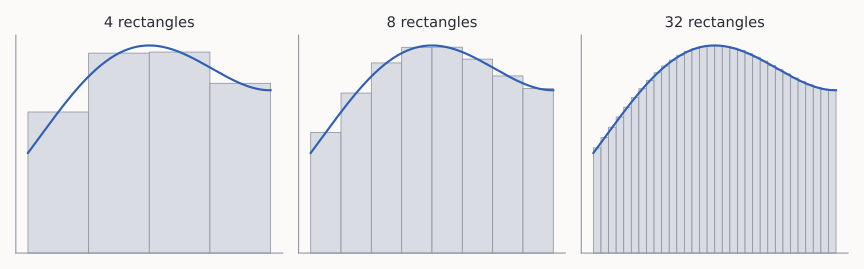
The integral as a limit of Riemann sums. Chapter 5 is this picture, made precise.
ProofsCopy link to section
- Needs
- Level 0 only
- Alongside
- Calculus
- Opens
- Every proof-based course, starting with real analysis, Linear algebra II and Abstract algebra
- Time
- about 80 hours
Book: Daniel Velleman, How to Prove It (3rd edition). Free alternative: Richard Hammack, Book of Proof.
The shortest subject on the map and the one with the best return. Without it, every book after Level 1 reads like a foreign language. With it, you can at least read the language, even when you can't yet speak it.
- Read now
- 1 Sentential logic · 2 Quantificational logic · 3 Proofs (all of it, slowly) · 4 Relations · 5 Functions · 6 Induction
- Later
- 8 Infinite sets (read it just before real analysis)
- Skip
- 7 Number theory, unless you enjoy it: abstract algebra covers what you need
Go fast through the logic chapters if they come easily. But do the exercises on negating quantified statements. That one skill is half of real analysis.
Linear algebra I: computationCopy link to section
- Needs
- Level 0
- Alongside
- Calculus, any part
- Opens
- Differential equations, Probability, Linear algebra II, Numerical analysis
- Time
- about 120 hours
Book: Gilbert Strang, Introduction to Linear Algebra (5th edition), with his MIT 18.06 lectures, free online.
Linear algebra is the one subject I'd deliberately learn twice. First as computation, then as structure. Doing both at once is why so many people find Axler hard and Strang shallow. They are two books for two moments.
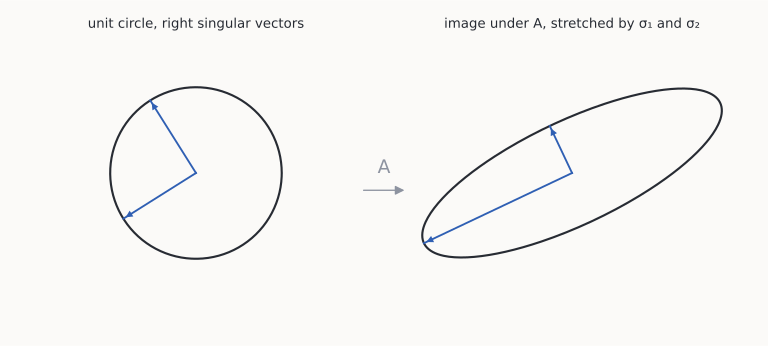
Every matrix sends the unit circle to an ellipse. The singular value decomposition (Chapter 7) tells you its axes. Most of Strang is about reading pictures like this off a matrix.
- Read now
- 1 Vectors · 2 Solving linear equations · 3 Vector spaces and subspaces · 4 Orthogonality, least squares · 5 Determinants · 6 Eigenvalues, including the section on systems of differential equations
- Later
- 7 Singular value decomposition (now if you care about data or machine learning)
- Skip
- 8 onward for now: Linear algebra II does linear maps better
Discrete mathematics (optional)Copy link to section
- Needs
- Proofs, Chapters 1 to 6
- Alongside
- Anything in Level 1 or 2
- Opens
- Combinatorics, algorithms, probability with counting
- Time
- about 60 hours
Book: Ronald Graham, Donald Knuth and Oren Patashnik, Concrete Mathematics.
Take this if you program, or if you like counting things. It's harder than its reputation, so treat it as a slow side project, not a course to finish.
- Read now
- 1 Recurrent problems · 2 Sums · 5 Binomial coefficients · 7 Generating functions
- Later
- 3 Integer functions · 4 Number theory · 8 Discrete probability · 9 Asymptotics
- Skip
- 6 Special numbers, unless you got hooked
Level 2: the second yearCopy link to section
This is where mathematics changes character. Level 1 was about computing. Level 2 is about proving. Expect the first few weeks of real analysis to feel slow. That's normal.
Series and several variablesCopy link to section
- Needs
- Calculus in one variable
- Alongside
- Linear algebra I, Proofs
- Opens
- Real analysis (series), Probability (multiple integrals), Differential equations, Complex analysis (line integrals)
- Time
- about 160 hours
Book: Stewart again, the second half.
- Read now
- 10 Parametric curves and polar coordinates (skip conics) · 11 Sequences and series, all of it · 12 Vectors and space · 13 Vector functions · 14 Partial derivatives · 15 Multiple integrals
- Later
- 16 Vector calculus: needed for complex analysis and PDEs, can wait if you're heading to algebra
People hate Chapter 11 because it feels like a bag of convergence tests with no reason behind them. The reason arrives in real analysis. Get through it anyway, real analysis assumes you've seen it once.
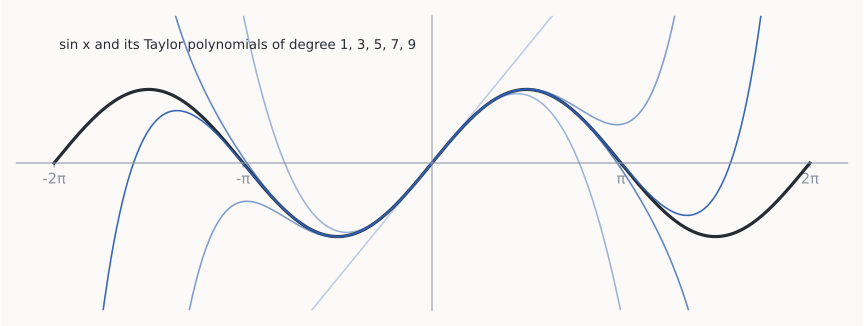
Each Taylor polynomial hugs sin x on a wider interval. Chapter 11 is about why, and how wide.
Real analysisCopy link to section
- Needs
- Proofs, and Stewart through Chapter 11
- Alongside
- Abstract algebra I, Linear algebra II
- Opens
- Function spaces and several variables, Complex analysis, Topology, Measure theory
- Time
- about 220 hours
Main book: Charles Pugh, Real Mathematical Analysis (2nd edition).
Gentle on-ramp, if you need one: Stephen Abbott, Understanding Analysis (2nd edition).
Pugh is the book I'd build the whole analysis track on. It's more complete and much more geometric than the usual alternatives: it does analysis in metric spaces from Chapter 2, it's full of pictures, and the exercise sets are enormous, from routine to qualifying-exam level. One book carries you from the real numbers to Lebesgue integration.
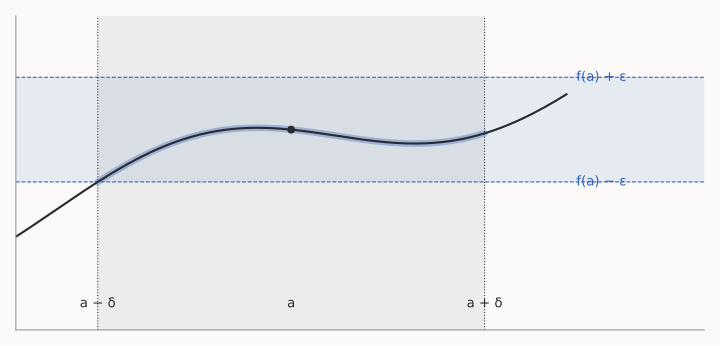
Continuity at a: whatever band of height 2ε you draw around f(a), some interval around a stays inside it. Most of Level 2 is learning to argue with this picture.
Abbott is more elementary and covers much less. It stays on the real line, it doesn't do several variables, and it doesn't do measure theory. What it does very well is explain why the definitions look the way they do. Use it if proofs are still new to you, as a first pass through Chapters 1 to 6 (count another 80 hours or so), then switch to Pugh. If Velleman went well, start directly with Pugh.
- Read now
- 1 The real numbers · 2 Sequences and series · 3 Basic topology of R, up to compact sets · 4 Continuity · 5 The derivative · 6 Sequences and series of functions
- Later
- 7 The Riemann integral (Pugh does it too)
- Skip
- 8 Additional topics · the end of Chapter 3 (Baire, perfect sets)
- Read now
- 1 Real numbers · 2 A taste of topology: metric spaces, compactness, connectedness · 3 Functions of a real variable: derivatives, the Riemann integral, series
- Later
- 4 Function spaces (Level 3) · 5 Multivariable calculus (Level 3) · 6 Lebesgue theory (Level 4)
Chapter 2 is where Pugh earns its place. Compactness in a general metric space, done with pictures, is the single idea you'll use most in everything after. Take your time there. With Pugh you won't do every exercise, there are hundreds. Do a third, chosen across the difficulty range, and come back to the starred ones a few months later. You'll be surprised how many have become easy.
What about Rudin's Principles of Mathematical Analysis? It's famous, terse and excellent, and if you work through Pugh you don't need it. Keep it as a second source when a Pugh proof doesn't click.
Linear algebra II: structureCopy link to section
- Needs
- Linear algebra I, Proofs
- Alongside
- Real analysis, Abstract algebra I
- Opens
- Functional analysis, Abstract algebra II (modules), Differential geometry, Numerical analysis
- Time
- about 120 hours
Book: Sheldon Axler, Linear Algebra Done Right (4th edition, free on his website).
This round is all proofs, and determinants arrive at the very end on purpose. Run it alongside analysis and algebra: the three keep reinforcing each other.
- Read now
- 1 Vector spaces · 2 Finite-dimensional spaces · 3 Linear maps · 5 Eigenvalues and eigenvectors · 6 Inner product spaces · 7 Operators on inner product spaces (the spectral theorem)
- Later
- 4 Polynomials (read it when Chapter 5 sends you there) · 8 Operators on complex spaces, Jordan form · 9 Multilinear algebra and determinants
Abstract algebra ICopy link to section
- Needs
- Proofs
- Alongside
- Real analysis, Linear algebra II
- Opens
- Abstract algebra II, Number theory, Logic
- Time
- about 150 hours
Book: Charles Pinter, A Book of Abstract Algebra (2nd edition, Dover).
Cheap, short, gentle, and the exercise sets are well designed: they build each new idea from small steps. Algebra and analysis don't depend on each other, so run them side by side. Alternating weeks works well for a lot of people.
- Read now
- 1–16 Groups, up to the fundamental homomorphism theorem · 17–25 Rings, ideals, integral domains, polynomials
- Later
- 26–33 Field extensions, ruler and compass, Galois theory (nicer the second time, in Abstract algebra II)
If your goal is applied mathematics, you can stop algebra after Chapter 25. That's more algebra than most analysts ever use.
Differential equationsCopy link to section
- Needs
- Calculus in one variable, Linear algebra I through eigenvalues
- Alongside
- Anything in Level 2
- Opens
- Dynamical systems, PDEs
- Time
- about 100 hours
Book: William Boyce and Richard DiPrima, Elementary Differential Equations and Boundary Value Problems (10th edition or later).
This needs no analysis at all. If you're a physicist or an engineer, do it right after Level 1, before anything else here.
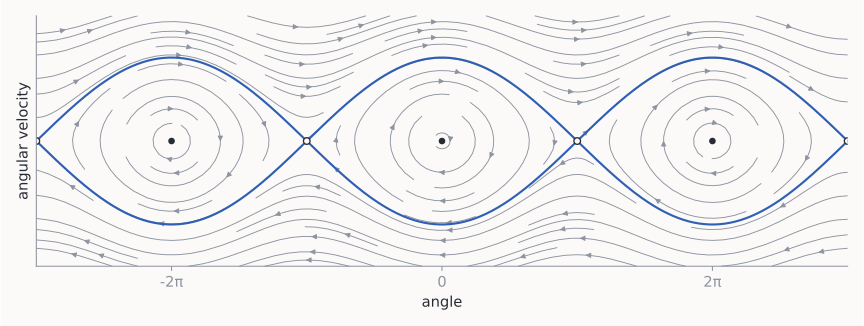
The pendulum in the phase plane. Inside the blue curves it swings, outside it spins over the top. Chapter 9 teaches you to draw this without solving anything.
- Read now
- 1 Introduction · 2 First-order equations · 3 Second-order linear equations · 7 Systems of first-order linear equations · 9 Nonlinear equations and stability
- Later
- 5 Series solutions (before PDEs, for Bessel functions) · 6 Laplace transform (now, if you're an engineer)
- Skip
- 4 Higher-order equations (skim: it's Chapter 3 with more indices) · 8 Numerical methods (write a Runge–Kutta solver instead) · 10–11 PDEs (the PDE course does it better)
ProbabilityCopy link to section
- Needs
- Stewart through Chapter 15 (joint densities are double integrals)
- Alongside
- Anything in Level 2
- Opens
- Statistics, Measure-theoretic probability
- Time
- about 150 hours
Book: Joseph Blitzstein and Jessica Hwang, Introduction to Probability (2nd edition, free PDF), with Blitzstein's Stat 110 lectures.
The best first probability book I know: it's all about thinking in stories, not formulas. It doesn't need analysis. The rigorous version, with measure theory, is a separate later step.
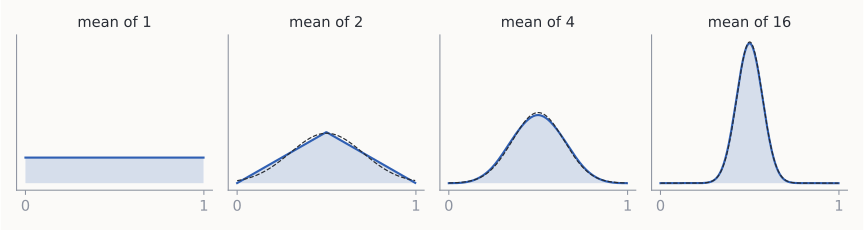
The mean of n uniform variables. By n = 16 it is almost exactly the dashed normal curve. That's the central limit theorem, and Chapter 10 proves it.
- Read now
- 1 Probability and counting · 2 Conditional probability · 3 Random variables · 4 Expectation · 5 Continuous random variables · 6 Moments · 7 Joint distributions · 8 Transformations · 9 Conditional expectation · 10 Inequalities and limit theorems
- Later
- 11 Markov chains · 12 Markov chain Monte Carlo · 13 Poisson processes
For statistics afterwards, Larry Wasserman's All of Statistics covers a full course in a few hundred dense pages. Read Part II, on inference, once Blitzstein and Hwang is done.
Level 3: the third yearCopy link to section
Now the tracks separate. You don't need everything here. Pick based on where you're going (there's a section on that below), but don't skip the analysis.
Function spaces and several variablesCopy link to section
- Needs
- Real analysis (Pugh 1–3), Linear algebra II
- Alongside
- Complex analysis, Topology
- Opens
- Measure theory, Functional analysis, Differential geometry, PDEs
- Time
- about 150 hours
Book: Pugh, the second half. Same book, which is exactly why it's worth choosing.
- Read now
- 4 Function spaces: uniform convergence, Arzelà–Ascoli, Stone–Weierstrass, the contraction principle and existence for ODEs · 5 Multivariable calculus: the derivative as a linear map, the inverse and implicit function theorems
- Later
- The end of Chapter 5 on differential forms and Stokes' theorem: read it before differential geometry
This is where ODEs from Level 2 get their existence theorem and where the derivative stops being a number.
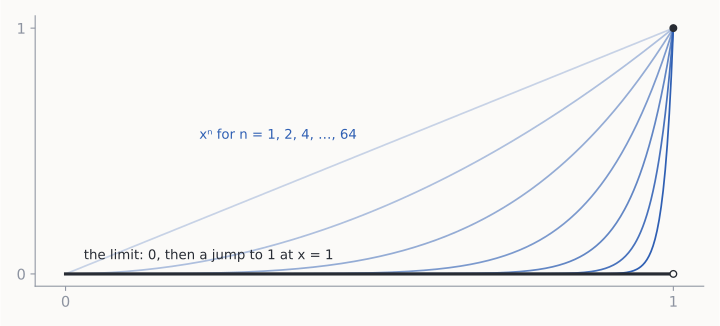
Continuous functions converging, point by point, to a function that jumps. Uniform convergence is the fix, and it's the first thing Chapter 4 is about. If several-variable analysis feels heavy here, Rudin's Chapter 9 is a good second explanation.
Complex analysisCopy link to section
- Needs
- Real analysis (Pugh 1–3 or Abbott 1–6), Stewart Chapter 16
- Alongside
- Function spaces, Algebra II
- Opens
- Analytic number theory, PDEs, Fourier analysis
- Time
- about 140 hours
Book: Elias Stein and Rami Shakarchi, Complex Analysis. For intuition alongside it, Tristan Needham, Visual Complex Analysis.
Stein and Shakarchi is dense but complete. Needham has no "required" chapters: open the matching part whenever a formula in Stein and Shakarchi makes no geometric sense to you.
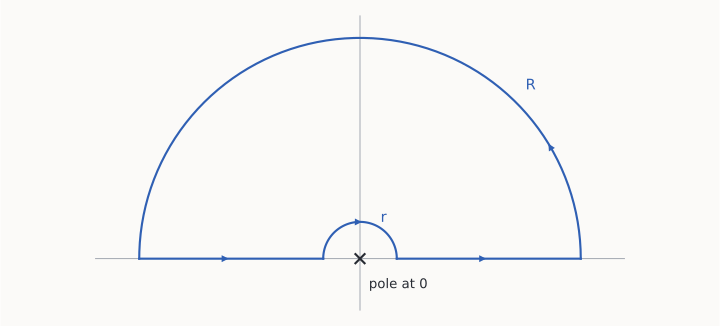
The contour behind the integral of sin(x)/x: a big semicircle, a small detour around the pole, and the real line in between. Chapters 2 and 3 give you everything needed to show the big arc contributes nothing.
- Read now
- 1 Preliminaries · 2 Cauchy's theorem and its applications · 3 Meromorphic functions and the logarithm
- Later
- 4 The Fourier transform (before PDEs) · 8 Conformal mappings · 7 The zeta function and the prime number theorem, just to see it done
- Skip
- 5, 6, 9, 10 on a first pass (entire functions, gamma, elliptic and theta functions)
Abstract algebra IICopy link to section
- Needs
- Abstract algebra I through Pinter Chapter 25, Linear algebra II
- Alongside
- Complex analysis, Topology
- Opens
- Galois theory, Algebraic number theory, Algebraic topology, Representation theory
- Time
- about 200 hours
Book: David Dummit and Richard Foote, Abstract Algebra (3rd edition).
Nine hundred pages and nobody reads it all. Treat it as a course, not a book.
- Read now
- 1–4 Groups, quotients, group actions, Sylow · 5 Direct products and abelian groups, first sections · 7–9 Rings, Euclidean domains, PIDs, UFDs, polynomial rings · 13–14 Field theory and Galois theory
- Later
- 10–12 Modules (before algebraic topology or representation theory) · 18–19 Representations of finite groups
- Skip
- 6 · 15 onward (graduate material)
TopologyCopy link to section
- Needs
- Real analysis, especially Pugh Chapter 2
- Alongside
- Algebra II, Complex analysis
- Opens
- Algebraic topology, Differential geometry, Functional analysis
- Time
- about 120 hours
Book: James Munkres, Topology (2nd edition).
After Pugh's Chapter 2, metric topology is familiar, so Munkres goes faster than people expect. The new part is topology without a metric.
- Read now
- 2 Topological spaces and continuous functions · 3 Connectedness and compactness · 4 Countability and separation axioms
- Later
- 7 Complete metric spaces and function spaces · 9 The fundamental group (this begins algebraic topology)
- Skip
- 1 Set theory (skim, you know it from Velleman) · 5, 6, 8 on a first pass
Dynamical systems (optional)Copy link to section
- Needs
- Differential equations
- Alongside
- Anything
- Opens
- Applied mathematics, mathematical biology, physics
- Time
- about 80 hours
Book: Steven Strogatz, Nonlinear Dynamics and Chaos.
Strogatz reads like a great lecture course, and you can do most of it. It's also the most fun book on this page.
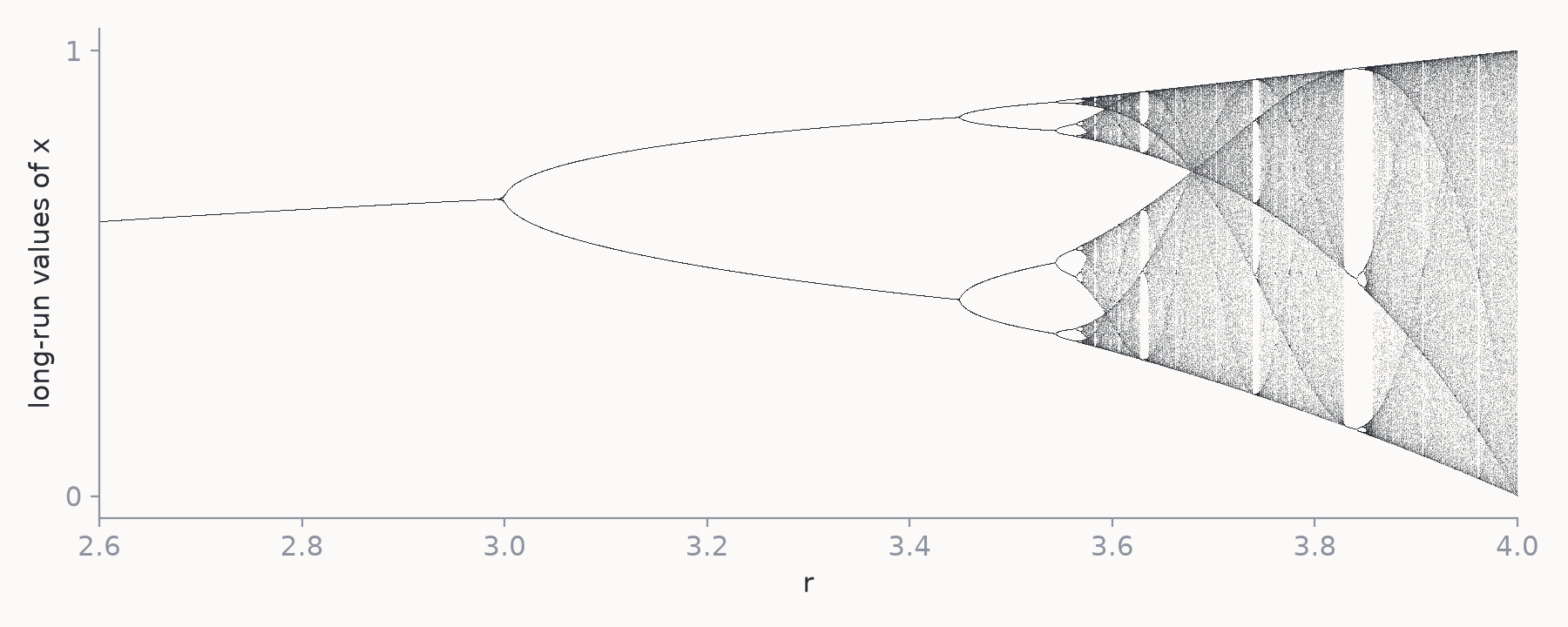
The logistic map x → rx(1 − x). One stable value, then two, four, eight, then chaos with windows of order. Chapter 10 explains all of it.
- Read now
- 2–4 Flows on the line and circle, bifurcations · 5–8 Linear systems, the phase plane, limit cycles, bifurcations in two dimensions
- Later
- 9 Lorenz equations · 10 One-dimensional maps
- Skip
- 11–12 Fractals and strange attractors, unless you got hooked
Number theory (optional)Copy link to section
- Needs
- Proofs; Abstract algebra I helps
- Alongside
- Algebra II
- Opens
- Algebraic number theory, cryptography
- Time
- about 80 hours
Book: Joseph Silverman, A Friendly Introduction to Number Theory. After Algebra II, Ireland and Rosen's A Classical Introduction to Modern Number Theory.
Silverman is made of short chapters. Read everything through quadratic reciprocity, then take whichever later chapters catch your eye (sums of squares, Pell's equation and elliptic curves are the classics).
Level 4: the doorway to graduate workCopy link to section
Each subject here is the first course of a whole field. You won't do them all. Pick two or three that point where you want to go.
Measure and integrationCopy link to section
- Needs
- Real analysis and Function spaces (Pugh 1–5), Linear algebra II
- Alongside
- Functional analysis
- Opens
- Functional analysis, Measure-theoretic probability, PDEs, harmonic analysis
- Time
- about 150 hours
Books: Pugh's Chapter 6 for a short first view. Sheldon Axler, Measure, Integration & Real Analysis (free PDF), for the full course.
- Read now
- 1 Riemann integration (why it isn't enough) · 2 Measures · 3 Integration · 5 Product measures and Fubini
- Later
- 4 Differentiation · 9 Real and complex measures · 12 Probability measures (before Durrett)
Functional analysisCopy link to section
- Needs
- Function spaces, Linear algebra II; measure theory for the L^p spaces
- Alongside
- Measure, PDEs
- Opens
- PDEs at graduate level, quantum mechanics, optimization, learning theory
- Time
- about 150 hours
Books: Axler's Measure, Integration & Real Analysis, Chapters 6 to 10. Or, without measure theory, Erwin Kreyszig, Introductory Functional Analysis with Applications.
- Read now
- 6 Banach spaces · 7 L^p spaces · 8 Hilbert spaces
- Later
- 10 Linear maps on Hilbert spaces, the spectral theorem for compact operators · 11 Fourier analysis
- Read now
- 1 Metric spaces · 2 Normed and Banach spaces · 3 Inner product and Hilbert spaces · 4 The fundamental theorems: Hahn–Banach, uniform boundedness, open mapping, closed graph
- Later
- 5 Banach fixed point · 7–9 Spectral theory and compact operators
- Skip
- 10–11 Unbounded operators and quantum mechanics, unless that's your field
Partial differential equationsCopy link to section
- Needs
- Several variables including Stewart 16, Differential equations, Function spaces (uniform convergence)
- Alongside
- Functional analysis
- Opens
- Mathematical physics, numerical PDEs, graduate PDE (Evans)
- Time
- about 140 hours
Book: Walter Strauss, Partial Differential Equations: An Introduction (2nd edition). Get the solutions manual.
- Read now
- 1 Where PDEs come from · 2 Waves and diffusions · 3 Reflections and sources · 4 Boundary problems · 5 Fourier series · 6 Harmonic functions · 7 Green's identities and Green's functions
- Later
- 9 Waves in space · 10 Boundaries in the plane and in space · 11 General eigenvalue problems · 12 Distributions and transforms (after functional analysis)
- Skip
- 8 Computation (write a finite-difference solver instead) · 13–14 on a first pass
This is where uniform convergence stops being abstract: Fourier series are the reason it was invented.
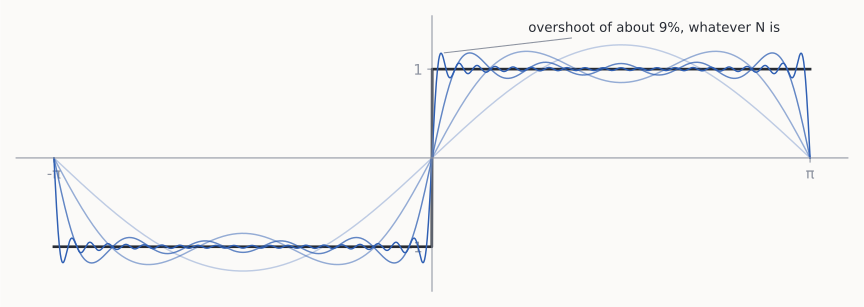
Fourier partial sums of a square wave. They converge everywhere except at the jump, where they always overshoot by about 9%.
Differential geometryCopy link to section
- Needs
- Function spaces and several variables (the inverse function theorem), Linear algebra II, Topology
- Alongside
- Algebraic topology
- Opens
- Riemannian geometry, general relativity, geometric analysis, information geometry
- Time
- about 150 hours
Books: Manfredo do Carmo, Differential Geometry of Curves and Surfaces, then John Lee, Introduction to Smooth Manifolds (2nd edition).
Do Carmo first, because curvature of a surface you can picture is much easier than curvature of an abstract manifold.
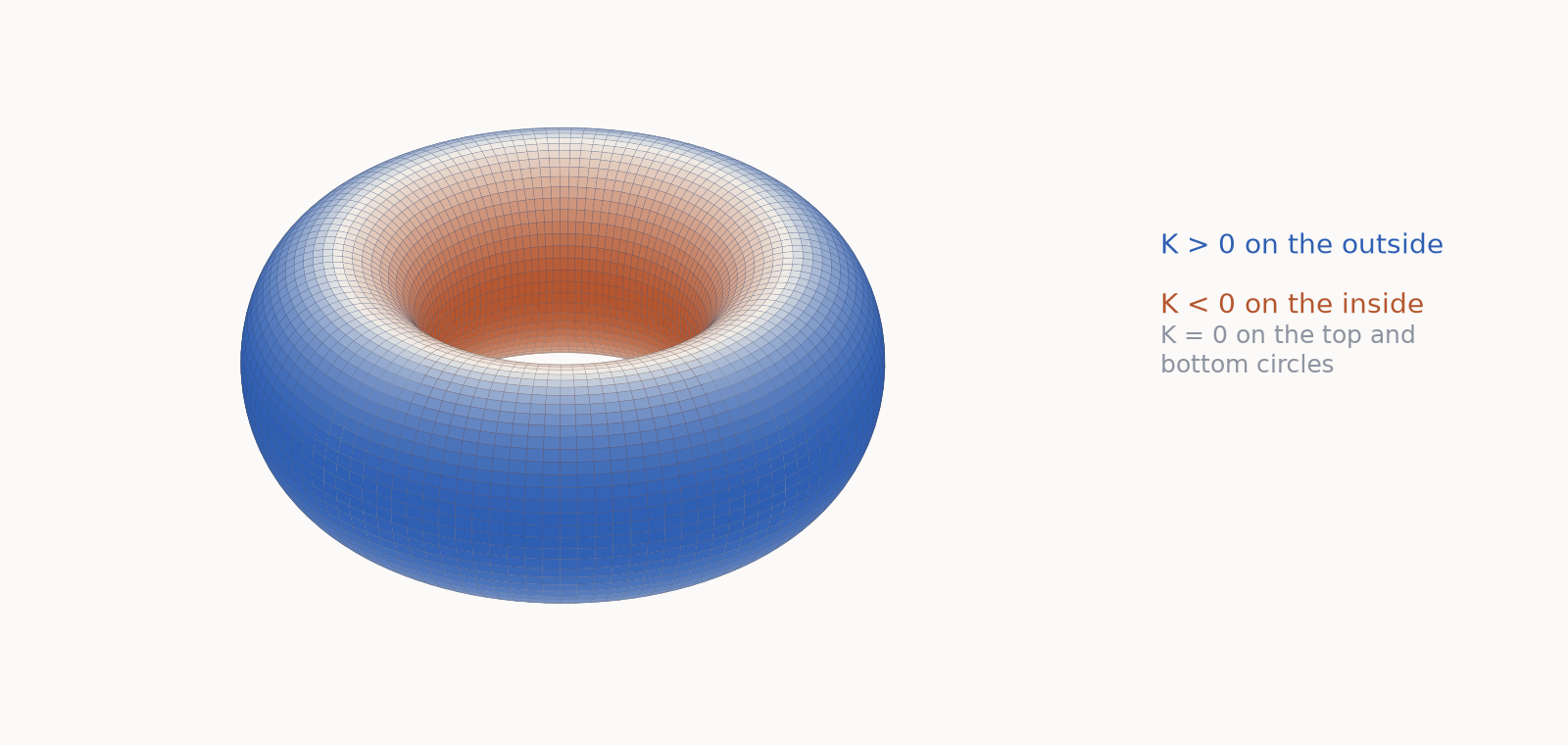
Gaussian curvature on a torus. Positive outside, negative inside, and it integrates to zero, as Gauss–Bonnet says it must for a surface with a hole.
- Read now
- 1 Curves · 2 Regular surfaces · 3 The geometry of the Gauss map · 4 Intrinsic geometry, up to Gauss–Bonnet
- Later
- 5 Global differential geometry
- Read now
- 1 Smooth manifolds · 2 Smooth maps · 3 Tangent vectors · 4 Submersions, immersions, embeddings · 5 Submanifolds · 8 Vector fields · 11 The cotangent bundle · 14–16 Differential forms, orientations, integration and Stokes
- Later
- 7 Lie groups · 9 Flows · 12 Tensors · 13 Riemannian metrics · 17 de Rham cohomology
Algebraic topology (optional)Copy link to section
- Needs
- Topology, Abstract algebra II (groups, modules)
- Alongside
- Differential geometry
- Opens
- Homological algebra, topological data analysis, category theory
- Time
- about 150 hours
Books: Munkres, Chapters 9 to 12, as a gentle start. Then Allen Hatcher, Algebraic Topology (free PDF).
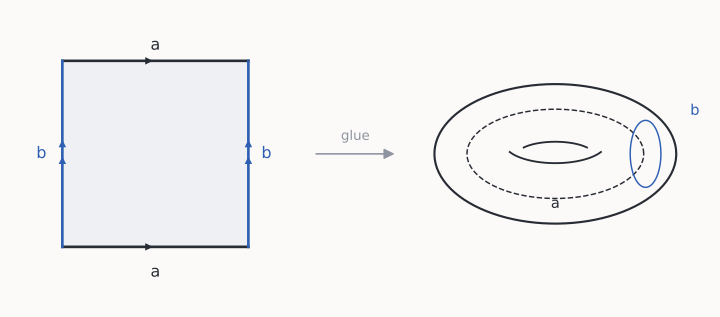
Glue the opposite edges of a square and you get a torus. Much of a first algebraic topology course is learning to compute with pictures like this one.
- Read now
- 0 Some underlying geometric notions · 1 The fundamental group, van Kampen, covering spaces · 2 Homology, up to Mayer–Vietoris
- Later
- 3 Cohomology
- Skip
- 4 Homotopy theory, on a first pass
Measure-theoretic probability (optional)Copy link to section
- Needs
- Probability, Measure and integration
- Alongside
- Functional analysis
- Opens
- Stochastic processes, stochastic calculus, statistical learning theory
- Time
- about 150 hours
Book: Rick Durrett, Probability: Theory and Examples (5th edition, free PDF).
- Read now
- 1 Measure theory (a fast review) · 2 Laws of large numbers · 3 Central limit theorems · 4 Martingales
- Later
- 5 Markov chains · 7 Brownian motion
- Skip
- 6 Ergodic theorems, on a first pass
Numerical analysis (optional)Copy link to section
- Needs
- Linear algebra I and II, some programming
- Alongside
- Anything
- Opens
- Scientific computing, optimization, machine learning systems
- Time
- about 100 hours
Book: Lloyd Trefethen and David Bau, Numerical Linear Algebra.
The book is written as forty short lectures in five parts. It changes how you see Strang's material: the question is no longer what the answer is, but how much of it survives floating point.
- Read now
- I Fundamentals · II QR factorization and least squares · III Conditioning and stability · IV Systems of equations
- Later
- V Eigenvalues · VI Iterative methods
Mathematical logic (optional)Copy link to section
- Needs
- Proofs, Abstract algebra I (for the feel of structures)
- Alongside
- Anything
- Opens
- Set theory, model theory, computability, proof assistants
- Time
- about 80 hours
Book: Herbert Enderton, A Mathematical Introduction to Logic (2nd edition).
- Read now
- 1 Sentential logic · 2 First-order logic, through the completeness theorem
- Later
- 3 Undecidability and Gödel's incompleteness theorems
- Skip
- 4 Second-order logic
For the practical side of logic, try a proof assistant at the same time. The Lean community's Mathematics in Lean is a good place to start, and it will show you very quickly which of your proofs were really proofs.
Choosing your routeCopy link to section
Nobody needs the whole map. Here are three routes, each a subset of it, with a rough schedule. Switch between them to see how differently the same subjects are spread out.
Pure mathematics. All of Levels 1 to 3 except the optional subjects you don't enjoy, then measure theory, functional analysis or algebraic topology, and differential geometry. This is close to a full undergraduate degree. At 10 hours a week, count about four years.
Machine learning and data. Calculus (both parts), Proofs, Linear algebra I with the SVD, Probability, then Real analysis (Pugh 1–3) and Linear algebra II. After that: Measure and integration, Functional analysis, Measure-theoretic probability, Numerical analysis. Algebra, complex analysis and PDEs can wait until a specific problem asks for them. Around two and a half years at 10 hours a week.
Physics and engineering. Calculus, Linear algebra I, Differential equations as early as possible, then Complex analysis (you can take Abbott as your analysis), PDEs and Dynamical systems. Add Functional analysis through Kreyszig if you're going toward quantum mechanics. Around two years.
The whole map in one tableCopy link to section
| Subject | Book | Read before moving on | Opens |
|---|---|---|---|
| Calculus, one variable | Stewart | Ch. 1–7 | Everything |
| Proofs | Velleman | Ch. 1–6 | All proof-based courses |
| Linear algebra I | Strang | Ch. 1–6 | ODEs, probability, LA II |
| Series, several variables | Stewart | Ch. 10–15, then 16 | Analysis, probability, complex |
| Real analysis | Pugh (Abbott first if needed) | Pugh Ch. 1–3 | Level 3 analysis, topology |
| Linear algebra II | Axler | Ch. 1–3, 5–7 | Functional analysis, algebra II |
| Abstract algebra I | Pinter | Ch. 1–25 | Algebra II, number theory |
| Differential equations | Boyce and DiPrima | Ch. 1–3, 7, 9 | Dynamics, PDEs |
| Probability | Blitzstein and Hwang | Ch. 1–10 | Statistics, Durrett |
| Function spaces | Pugh | Ch. 4–5 | Measure, functional analysis, geometry |
| Complex analysis | Stein and Shakarchi | Ch. 1–3 | Number theory, PDEs |
| Abstract algebra II | Dummit and Foote | Ch. 1–5, 7–9, 13–14 | Algebraic topology |
| Topology | Munkres | Ch. 2–4 | Algebraic topology, geometry |
| Measure | Axler (MIRA) | Ch. 1–3, 5 | Probability, functional analysis |
| Functional analysis | Axler (MIRA) or Kreyszig | MIRA 6–8 or Kreyszig 1–4 | Graduate analysis |
| PDEs | Strauss | Ch. 1–7 | Graduate PDE |
| Differential geometry | do Carmo, then Lee | do Carmo 1–4 | Riemannian geometry |
Moving on too early, or too lateCopy link to section
Too early looks like this: in the new book, the new ideas make sense but the old ones keep tripping you. Every proof in Pugh stalls on a quantifier you can't negate. Every eigenvalue in Boyce and DiPrima takes twenty minutes. The fix is narrow: one section of the old book, ten exercises, back.
Too late looks different. You've been on the same book for months, you're on the hardest starred exercises, and you dread opening it. Or you're starting a third read of a chapter "to really get it". That's the signal. Move on. The next book will either show you that you understood it after all, or show you exactly which part you didn't.
A two-week break costs a few days of review, not the course. A six-month break costs more, but less than you fear: the second time through a chapter is always faster than the first.
If I had to fit this whole post in one sentence: finish fewer books, and finish the right chapters of them.